

Douglas Newby Insights - Page 11
Wired Ball

What a great name, Wired Ball, shown on the hand lettered sign, for a croquet party at the home of the Stevens family on the corner of Swiss Avenue and Haskell. Laura Stevens Chadwick, whom I discussed in my previous post, sent me this photograph of her grandmother’s house with her father measuring the distance of the ball to the wire wicket, along with several young ladies in fashionable croquet dresses. This picture arrived in my mailbox not long after I participated in a Multiple Sclerosis Society fundraising Bachelor Bid Auction, in which I participated along with several of my supportive friends on Swiss Avenue. They hosted a progressive dinner with each course at a different home on Swiss Avenue making up my bid package. In the Bachelor Bid book, I was photographed holding a croquet mallet, as I thought this conveyed the gilded age of Swiss Avenue. It was so fun to receive this photograph validating my impression of Swiss Avenue. The winning bid was $5,500, a meaningful contribution to the cause. Kenny Novorr’s home at 5303 Swiss Avenue was the first home built on the street in 1905 and it was featured on the progressive dinner. It is probably close to the age of the home on Swiss and Haskell. Both homes had elements of Victorian architecture but had made the transition to a more nuanced Prairie style. When Laura Stevens’ grandfather moved to Dallas in 1870, she said the streets were mud with wood planks. When her grandfather suddenly died, her mother moved from the Stevens Park area to the home on Swiss and Haskell. She said the house in the photograph further down the street was the Chilton home. May is a month of preserving homes, preserving memories, and creating new homes worth preserving in the future. *Wired Ball
#SwissAvenue #DallasNeighborhood #Dallas #Croquet #LawnParty #HistoricHome #PeakSuburbanDistrict #MungerPlace #OldEastDallas
#HistoricPreservation #PreservationMonth
Neighborhoods Evolve

During Preservation Month in May, I would like to share two photographs I received from correspondence with Laura Stevens Chadwick 35 years ago about neighborhoods. As a result of my work as a real estate broker and my interest in Dallas neighborhoods and history, I occasionally received little treasures like the original architectural plans for the Bianchi house on Reiger designed by architects Lang & Witchell or in this case the photograph of 3013 Swiss. The picture is of Laura Chadwick’s grandmother’s house on her mother’s side where Laura was born. It is one block down from the Wilson block of Victorian houses assembled and renovated by the Meadows Foundation for nonprofit offices, including the 1902 Preservation Dallas office. By 1905, Prairie influence was transitioning away from Victorian style, and by 1910 all new homes had Prairie elements. While the Meadows Foundation renovated Victorian houses for offices, Munger Place homeowner Jim Aiken moved two Victorian houses to Munger Place and renovated them along with several Prairie style homes in Munger Place that he sold to homeowners. Jim did on Reiger what Don Criswell and his neighbors did on their block. They purchased divided-up rent houses and renovated them so that families would buy them for single family homes. Fred Longmore did the same thing on Tremont and Victor. All these Munger Place homeowner preservation efforts were before Virginia and Lee McAlester and I created the Revolving Fund to do much the same thing but with the profits going to the Historic Preservation League so they could hire their first Executive Director, Susan Mead. Earlier this year, a 1990 Victorian style home on Gilbert in Oak Lawn sold. It was one of the rare Victorian style homes to be built in the last 100 years. Virtually every other 20th century style has been successfully revived. For this reason, architecturally significant homes in these popular styles should be easier to preserve, not harder. In addition, new homes in these classic styles should continue to contribute to the rich architectural landscape. *Neighborhoods Evolve
#WilsonBlock #PreservationDallas #MungerPlace #MeadowsFoundation
May Day

May Day is always one of my favorite days–associated with wildflowers, May baskets, and a festive mood halfway into spring. What better way to celebrate May Day than with vibrant friends who celebrate Dallas all year with their accomplishments. What better place to celebrate May Day than dinner on the garden patio of Cafe Pacific on a beautiful evening. Notre Dame was also celebrated, which is fitting since the day has tributes made to Virgin Mary. The former Notre Dame student council president, now owner and Chief Wagoneer of Radio Flyer, upon hearing that fellow transportation titan from Notre Dame was celebrating May Day along with progeny of a Notre Dame All-American football player, sent miniature Radio Flyer wagons as May basket table favors. May Day also is the first day of Preservation Month. Who better to celebrate Preservation Month with than Amy and Les Ware who have accomplished the most important home restoration of the century in Highland Park and Dallas. On a massive lot this English-style architecturally significant home designed by C.D. Hill was doomed for destruction. In the good hands and aesthetic sophistication of the Wares, the 100-year-old home on Beverly was restored and seen at the Patron Party of the Park Cities Preservation Tour. May Day also has a more ominous meaning, one of warning. A splendid celebration at Cafe Pacific reminds one of the fragility of time-honored places and institutions deeply engraved in our lives that need to be preserved. Is there anywhere in Dallas that embodies the grace, elegance, sense of perfection and fun that Highland Park homeowner Jack Knox has created at Cafe Pacific–a restaurant as relevant today as 30 years ago? Also in the house on May Day, were the 3 best chefs in Dallas: Dean Fearing and Stephan Pyles as guests and Chef Terry Cook in the kitchen, along with dignitaries, Highland Park families, young couples, all treated like royalty and longtime friends. As we think about Preservation in May, may we devote time to think about preserving the magic of Cafe Pacific and its contributions to Highland Park for years to come. *May Day
#CafePacific #JackKnox #HighlandParkVillage #HighlandPark
Welch Pavilion at Lake
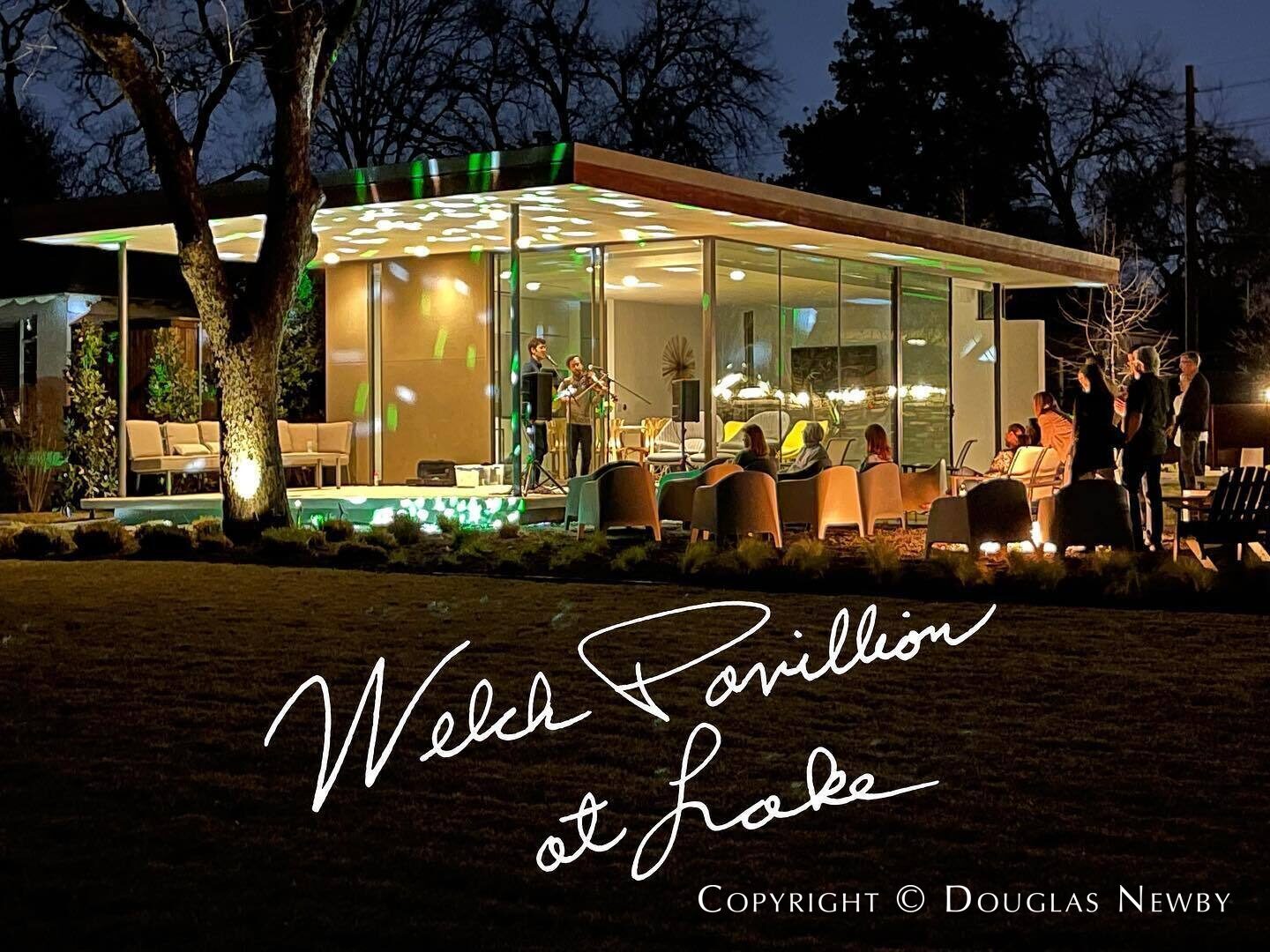
A house concert with a chamber music intimacy at the spectacular guest pavilion designed by architect Cliff Welch was a perfect way to kick off spring, celebrate the elevation of Cliff Welch to an AIA Fellow, and the re-emergence of Welch architecture as Cliff again concentrates his practice on what he loves most and does best, designing architecturally significant modern homes. At this beautiful and serene setting, we were able to hear the music of the talented Jackson Emmer, a singer and songwriter, and converse with many Cliff Welch clients who exchanged their reflections on how much they enjoy the modern home Cliff Welch designed for them. The modern home of Katherine and Bruce Winson on West Lake Highlands Drive is a home imbedded in every cyclist’s mind as it is always a treat to see it from the lake and is a reward for climbing the hill to see it up close. Thank you to all those who have retained Cliff Welch to design their homes so the rest of us can enjoy his work. Thank you to Joe McCall, FAIA, a brilliant modern architect and leader in his profession, for nominating and sponsoring Cliff to become an AIA Fellow, and to Cliff for his continued good work and contribution to the community. *Welch Pavilion at Lake
#ModernHome #DallasNeighborhood #WhiteRockLake #Pavilion #Dallas #JacksonEmmer @CliffWelchAIA @JoeMcCallFAIA @JacksonEmmer #Architect #DallasArchitecture #ArchitecturallySignificant #ModernDesign #HouseConcert #DallasContemporaryDesign
Disappearing Details

Iconic street, iconic home, iconic architect. Facing the last few moments of the life of a home, one reflects on the home’s impact and why it made such an impact. It is the composition and articulation of Hal Thomson’s architectural detail at 4908 Lakeside that made this home the most iconic and admired home on Lakeside Drive. I have even come to the conclusion that the reason Highland Parks’ Lakeside Drive has been thought of as one of the five iconic streets in Dallas is because of this Hal Thomson-designed home and its flourishes of restrained romantic details perfectly proportioned and distributed. When one thinks of Lakeside Drive, one thinks of this Old Highland Park home. It is these details that have sustained Henry B. Thomson as the iconic Dallas architect of the early 20th Century. Hal Thomson is the one Dallas architect admired by all current architects of Dallas and revered by historicist architects who are inspired by his work. I recall the late Ted Pillsbury, the former director of the Kimball Art Museum remarking on the perfect composition and details of his favorite Dallas home—one by Hal Thomson. I continually find myself visually stopping at each Hal Thomson house when I ride my bike on Swiss Ave. These homes are familiar as I have ridden by them thousands of times. The Hal Thomson houses seemingly blend into the landscape of other architecturally significant homes on the street that are of a similar size and setback, yet the Hal Thomson houses catch my attention every time. I look closer and wonder why the home has such profound effect on me. I come to the conclusion it is the details. The details are romantic, elegant and refined, but are subtle, the last thing you notice. Slide through to see images of details hopefully imprinted in our minds and of architects. Great community sentiment came for the home to be saved. Beyond contacting the owners, what efforts were made over the last year, 5 years, 25 years to save the home. Additional strategies are needed. We need to start saving homes. *Disappearing Details
#HighlandPark #HistoricPreservation #HighlandParkPreservation #HomesTornDown #CurbAppeal #HalThomson #HistoricHomes #Architect
Start Saving Homes

Over 25 years ago, the AIA Dallas Chapter selected this Hal Thomson designed home pictured here at 4908 Lakeside in Highland Park as a Dallas 50 Significant Home for their 50th Anniversary. For 75 years before that, this Highland Park home had been considered the iconic home on Lakeside. The question should not be — when are people going to stop tearing down historic homes? – but when are proactive steps going to be taken to save historic and architecturally significant homes? Officially, for 25 years, we all have known that this Hal Thomson designed Highland Park home was historically and architecturally significant and needed to be preserved. Have any preservation steps been taken to show how the home could be renovated or expanded, maintaining its architectural facade and integrity while making the home more economically compatible with the value of the lot? In my recent DouglasNewby.com blog series, Five Preservation Steps to Save Homes, I discussed in Preservation Steps Three and Four how architects, interior designers, contractors, and appraisers can create a vision and validate the value of a renovated home of this elegance and importance to make it easier to save. It is hard to stop a home from being torn down when bulldozers are in place. Historic and architecturally significant homes can be saved if proactive preservation steps are taken. When are we going to start saving homes? *Start Saving Homes
#HalThomsonArchitect #HistoricHome #Preservation #HighlandPark #LakesideDriveHighlandPark #HalThomson #Architecture #Architect #NeoclassicalArchitecture #ArchitecturallySignificant #ArchitecturallySignificantHomes #HistoricHomes #OldHighlandPark #AIADallas #PreservationParkCities #Dallas #SavingHomes #curbappeal #DallasHistoricHomes #HomesTornDown
Dallas Salon

I consider the Harlan Crow Library the epicenter of history, political and economic discussions. This architect-designed, architecturally significant library, located in the middle of Dallas and Highland Park, with a serious collection of books and letters that Harlan Crow is intimately familiar with, is a perfect spot for those in Dallas, across the country, and from around the world to convene and exchange ideas. Recently, Douglas Bradburn, the President and CEO of George Washington’s Mount Vernon, came here to interview Pulitzer Prize-winning author Rick Atkinson and discuss his recent book, The British Are Coming, Volume One of the Revolution Trilogy. Hearing how George Washington was not a brilliant general but was a brilliant leader, and the overarching themes of the war and minute details of the participants, from two of our country’s foremost historians, was enthralling. Making it even more invigorating, was standing and listening by chance next to library shelves of early first edition books on George Washington. The Mount Vernon estate has been a historic and cultural symbol of the United States for over 200 years. It is also an architectural icon and we see many homes that are inspired by Mount Vernon in Dallas. The Mount Vernon Ladies’ Association, who sponsored the event, organized by incredible Gloria Snead, purchased the Mount Vernon estate from the Washington family in 1858 and has welcomed 96 million guests to George Washington’s home. My family is descended from William Ball I, who was George Washington’s grandfather. William Ball V’s daughter, Elizabeth Ball, married William Newby, from which the Newby/Ball line descended, including William G. Newby, who donated William G. Newby Memorial Building to the Women’s Club of Fort Worth, founded in 1923. This is on the National Register of Historic Places.
The William and Elizabeth Ball Newby 500-acre farm in Virginia’s Shenandoah Valley was deed restricted so it could not be divided up. When I visit Forth Worth or Virginia, I am tempted to go by my first name–William. *Dallas Salon
#mount_vernon #HarlanCrowLibrary #HighlandPark #Dallas #DallasArchitecture #ArchitecturallySignificant #Library
Farewell to Lights

A vintage 1979 Mercedes 450 SL, the color, vicuna with a chocolate brown top, in Highland Park always makes one either sentimental or envious of such a cool car. But what car would you expect of a nationally celebrated interior designer, Susan Bednar Long and her husband John, to drive to the village for dinner? I always love driving by their beautifully restored historic home on Beverly Drive and enjoy the look even more now when I see this car in the motor court. Also, one gets sentimental about the Highland Park lights. This image was taken on the last night of the Highland Park lights shining before they get turned off and then turned on next fall. As we say farewell to the lights, we know spring is on the way. *Farewell to Lights
@SBLongInteriors @jbrlong3 #Mercedes450SL #HighlandParkVillage #CafePacific #HighlandParkTX #DallasNeighborhood #HighlandParkNeighborhood #Design #InteriorDesigner #SusanBednarLong #JohnBRLong3
Contemporary Contrast

This home best illustrates the point I made in my TEDx talk, Homes That Make Us Happy, that it is not a particular style of home that makes one happy but the design of a home that makes one happy. Good design is good design. This Victorian style home might be the only new Victorian style home built in Dallas in the last 25 years. Its style is a severe contrast to the prevailing popularity of Modern and Transitional Modern. A new Victorian style home might even be considered architectural sacrilege by the professional intelligentsia. However, this home has good design and attracted many buyers, including those that have previously owned architect-designed Modern homes and others that live in Transitional Modern homes. These modern home lovers were all attracted to the wide front porch elevated high off the street, the rear porch, and the many windows. Mid-century Modern homes of this size generally have 8 ft. ceilings. Historic homes of this size have 8 ft. to 9 ft. ceilings. This Victorian style home built in 1996 has 10 ft. ceilings and wide double passageways with pocket doors opening to other large rooms. It also has a very wide gallery that runs the length of the home—perfect for entertaining. The floorplan programmatically feels modern. The home also attracted multiple buyers from New Orleans, which should not be a surprise. Many coming from New Orleans bought homes in Munger Place and Swiss Avenue, as they were attracted to the wide front porches and the balcony porches that they were raised with. D Magazine called this one of the “ten most charming houses in Dallas” in 2019. In 2022, modern home aficionados just called this a cool house with great spaces. *Contemporary Contrast
#Victorian #OakLawn #CurbAppeal #DallasNeighborhood #Dallas #Architecture #VictorianStyleHouse #Dallas Home #HomesThatMakeUsHappy
Modern Muse

The concept of a muse has always fascinated me—fashion designers often have their muse floating in and out of a studio and historically artists were known to paint their paramours as their subject. What I love about this modern muse is she is the wife of the very talented artist, Will Murchison. At a recent show, Will said, when I asked, that he was not trying to paint his wife when he was composing and painting this layered piece of organic shapes on an asymmetrical grid, but he agreed that there did seem to be a similarity between the female in the painting and his wife. Will Murchison’s work is both intellectually thought out and spontaneously painted. It is a delight to know that when Will goes into his deepest subconscious for inspiration, his beautiful wife appears. *Modern Muse
@ErinCluleyGallery #DallasArtist #DallasArt #WillMurchison #DallasArtGallery #Muse #modernartists